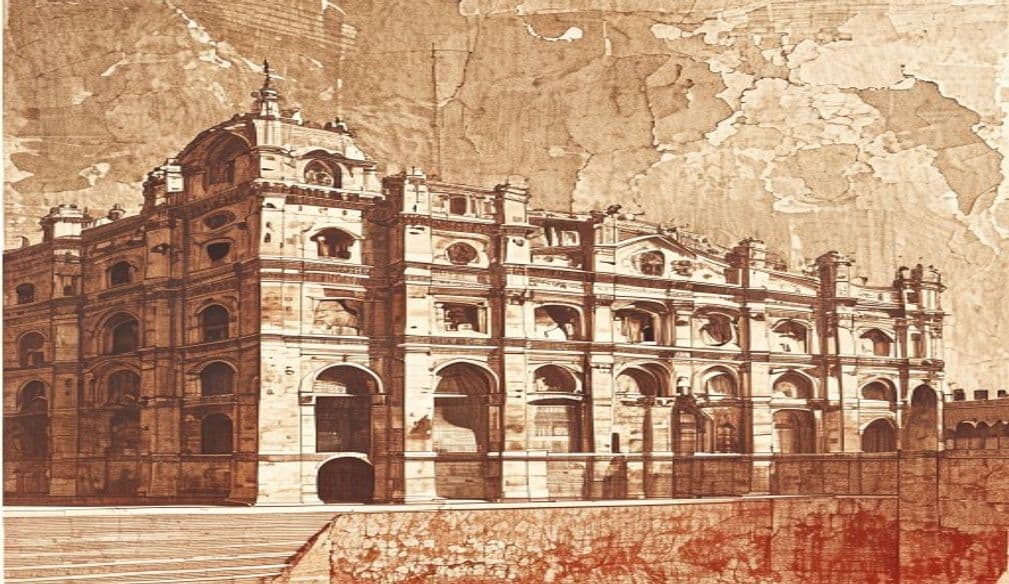
Before entering: the exterior
The outer façade and bastions
Before buying your ticket, it is worth circling the outer structure. The four angular bastions (15th–16th century) still bear the names of the evangelists: San Marco, San Luca, San Giovanni, San Matteo. They are built in brick with a battered profile — designed to deflect cannonballs.
The moat running around the structure was dug and deepened in the 16th century. Today it is a linear park where Romans and visitors stroll.
Ponte Sant'Angelo
The natural approach is Ponte Sant'Angelo, with its ten angel statues by Gian Lorenzo Bernini and workshop. Each holds an instrument of Christ's Passion. A fact most visitors pass without knowing: two of Bernini's original statues are not on the bridge but inside the church of Sant'Andrea delle Fratte — replaced by copies in the 17th century to protect them from erosion.
Entrance and the Courtyard of the Cannonballs
From the entrance you enter the Cortile delle Palle (Courtyard of the Cannonballs) — named for the cannonballs that line its edges. From here the full vertical structure opens up to view.
Notice immediately: the visual layering of the building is already readable here. The lower structures, in heavy travertine, are Roman. Brick walls of various periods build up toward the top. The medieval cylinder dominates the centre.
Level 1: the Roman helicoidal ramp (20 minutes)
The helicoidal ramp is one of the museum's most evocative spaces. It is not just any corridor: it is the same route that imperial funeral processions followed to bring the urns to the burial chamber.
What to observe along the ramp:
- The Roman brick walls (distinguishable from the overlying medieval masonry)
- The lateral niches: originally housed statues or lamps
- The slit-window openings above: brought light and air even 9 m above the ramp
- The floor surface: original Roman cobbling in some sections
At the top of the ramp the burial chamber opens: an unexpected silence at the heart of the structure.
Level 2: the Courtyard of the Angel and the Armoury (30 minutes)
The Courtyard of the Angel
The most photographed interior moment is the Angel by Raffaello da Montelupo in the central courtyard. The white marble statue, about 2.5 m tall, is the original that crowned the summit until 1752.
What to notice: the statue's gesture of sheathing the sword is almost dance-like — very different from the rigidity of the bronze copy on top. The facial expression is more human and less heroic.
The Armoury
The weapons collection occupies several rooms on this floor. It is not simply a display of objects: it tells the story of the evolution of warfare in Rome across four centuries.
Not to miss:
- The complete 15th-century knight's armour (complete preservation is rare)
- The fortress mortars of the 16th century — designed to bombard approach roads
- The section on portable firearms: the transition from arquebus to wheel-lock pistol
Level 3: the storerooms and the Treasury Room (20 minutes)
The Treasury Room (or Sala del Sacco) impresses with its monumental cylindrical form. The nearly 2 m thick walls and the absence of windows reveal its function: a physical strongroom. At various times it held the papacy's gold, popes' family jewels, and confidential papal documents.
A detail most visitors overlook: along the wall the inventory of the treasury of Pope Sixtus IV (15th century) is still legible — one of the richest in Church history.
The Columned Halls — oil and grain stores — have an almost chthonic atmosphere: dim light, low vaults, original amphorae.
Level 4: the papal apartments (45 minutes)
This is the level that requires the most time and attention.
Sala Paolina
Stand in the centre and turn slowly. Perino del Vaga's complete decorative programme (1545–1547) can only be understood by seeing it as a whole:
- The scenes with Alexander the Great: patron Paul III identified himself with the Macedonian conqueror
- The Roman allegories in the upper frieze
- The painted false architecture: illusionistic columns and cornices that expand the perceived space
Photograph tip: stand in the north-east corner of the room to include three walls in a single shot.
Camera del Perseo and Camera dell'Amore e Psiche
Two unexpectedly intimate rooms after the grandeur of the Sala Paolina. The Camera dell'Amore e Psiche is decorated with a series of lunettes showing the mythological story with great narrative grace.
The Loggias of Paul III
If open, this is the finest panoramic point at this level. A direct view down onto Ponte Sant'Angelo with Bernini's angels in the foreground, the historic centre stretching behind.
Level 5: the terrace (30 minutes)
The terrace is also a defensive bastion: walking around it, the military logic of the stronghold becomes clear. The firing positions were calculated to cover every angle of approach from the river.
The bronze Angel close up: few visitors approach the base of Verschaffelt's statue. Seen from nearby, the figure is more slender than it appears from below. The sword still shows the marks of the original 18th-century mounting.
The panorama: on a clear day you can see as far as the Castelli Romani (25 km to the south-east). To the north, the Sabine Hills.
Recommended timings
| Section | Recommended time |
|---|---|
| Exterior + bridge | 20 min |
| Helicoidal ramp + burial chamber | 20 min |
| Armoury + Courtyard of the Angel | 30 min |
| Storerooms + Treasury | 20 min |
| Papal apartments | 45 min |
| Terrace | 30 min |
| Total | ~2h45 |
Visit with a private driver
Explore every corner of Castel Sant'Angelo without worrying about transport: your driver waits at the exit. Service from €49. → Book at myromedriver.com
Frequently Asked Questions
Is it better to visit with an audio guide or a guide? The official audio guide is sufficient for the military sections. For the papal apartments a specialist guide adds considerably.
Is the entire route uphill? The Roman section is on the ramp. From level 2 upwards there are normal stairs and a lift.
What is the minimum recommended visit time? 90 minutes to see the essentials without rushing; 2.5 hours for a complete experience.