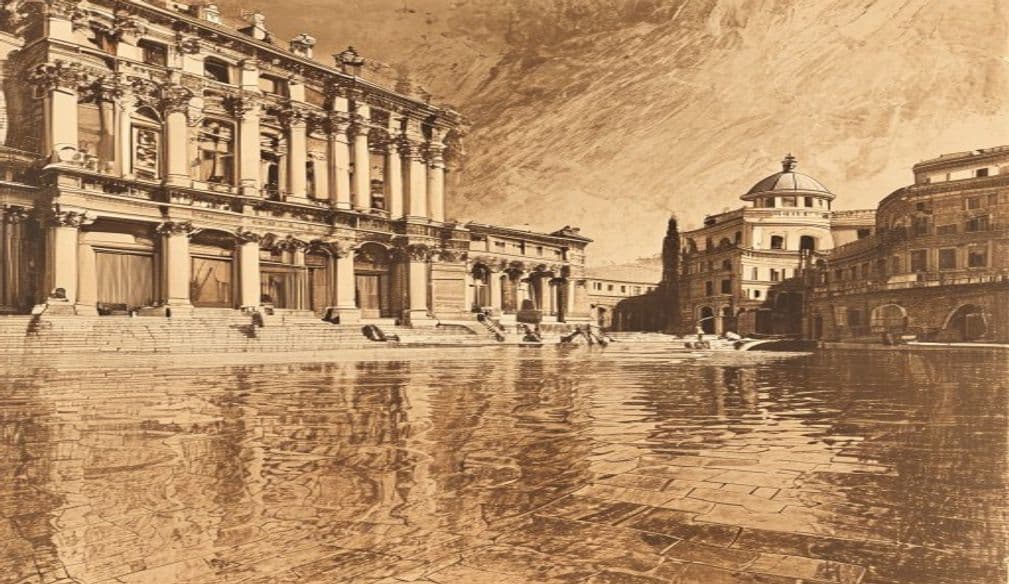
The main problem: the crowd
The Trevi Fountain piazza measures approximately 900 m². During peak season at busy hours, there are 3,000–4,000 people. The probability of taking a photo without heads in the foreground during the middle of the day is virtually zero.
The solution is not photographic technique — it is the choice of time.
The two golden windows
First window: before 8:00
Between 6:30 and 7:30 the fountain is almost deserted. The morning light illuminates Neptune and the sculptures directly and sharply. Colors are saturated, the white marble gleams against the travertine.
Advantages: maximum freedom of position, shots without crowds, clean lateral or frontal light. Disadvantages: in summer the sky is already very bright by 7:00, which can create overexposure in the background.
Second window: after 21:00
The fountain is illuminated until approximately midnight. After 21:00 in low season and after 22:00 in high season the piazza gradually empties. Artificial light creates golden reflections on the water and sculptures.
Advantages: unique atmosphere, almost no visitors after 22:30, possibility of long-exposure shots. Disadvantages: tripod required for long-exposure shots, risk of vibration from passersby.
Shooting positions
Frontal from the center of the piazza
The classic position. Symmetrical framing with Neptune at the center, horses and tritons to the sides, Palazzo Poli as backdrop. To achieve good symmetry you must position yourself exactly at the center of the balustrade.
Recommended distance: 8–12 meters from the basin. Closer and you lose the overall view; further away the fountain becomes small relative to the space.
Left side (from Via della Stamperia)
An angle that favors the left sculptural group — Filippo della Valle's Abundance — with a diagonal perspective on the backdrop of Palazzo Poli. A less common shot, more compositionally interesting.
Right side
Angle toward the right sculptural group — Healthfulness of the Waters — with the niche and basin in perspective. Ideal for including the richly decorated right side of the monument.
From below (front row of the balustrade)
Approaching the balustrade you can include the basin and foreground with coins underwater. A very common but effective shot for conveying the scale of the monument.
Recommended technical settings
Daylight (early morning)
- ISO: 100–200
- Aperture: f/8–f/11 for maximum sharpness across the entire sculptural surface
- Shutter: 1/125–1/250 s to freeze the water jets
- Focal length: 24–35mm on full frame to include the entire fountain from the frontal position
Night light (without tripod)
- ISO: 3200–6400
- Aperture: f/2.8–f/4
- Shutter: 1/30–1/60 s (handheld limit)
- Note: with high ISO digital noise can be high; better to shoot in RAW
Night light (with tripod)
- ISO: 100–400
- Aperture: f/8
- Shutter: 2–10 seconds — long exposure turns water into silk and amplifies reflections
Recommended lenses
Wide angle (16–35mm): allows including the entire fountain even from close range. Risk of distortion at the edges with very short focal lengths.
Standard (35–50mm): the focal length closest to the human eye. Reproduces the real proportions of the monument without distortion.
Telephoto (85–200mm): excellent for details — Neptune's face, the bas-reliefs on the base, the coins on the basin floor. Not suitable for panoramic shots.
Practical tips
Arrive before dawn in summer: in June and July sunrise is around 5:30. By 6:00 the piazza is still free and the light is soft and warm.
Use burst mode: in the brief windows when the piazza partially empties, shoot in bursts to increase the chances of having at least one shot without people in the foreground.
Watch for wet paving: the fountain water splashes slightly on the basin side. The sampietrini cobblestones can be slippery — protect your equipment.
Tripod and regulations: in some parts of the piazza, police may ask you to remove the tripod during peak hours for safety reasons. Check the situation on arrival.
Smartphone vs camera: modern smartphones with 50+ megapixel sensors deliver excellent results in good light. At night, dedicated camera sensors remain superior for noise quality.
Getting to the fountain for a photoshoot
The Trevi Fountain is in a ZTL zone: private cars cannot enter. For a professional photoshoot with heavy equipment (multiple tripods, portable lighting, wardrobe), a private driver service allows you to drop off materials in nearby streets without logistical stress.
Plan your photoshoot at the Trevi Fountain with a private driver: transfer your equipment comfortably and arrive at dawn when the fountain is still empty. Service from €49. → Book your driver at myromedriver.com
Frequently asked questions
What is the best time to photograph the Trevi Fountain? Before 8:00 for natural light, or after 21:30 for artificial light and a less crowded piazza.
Is a tripod necessary? Not for daytime shots. For long-exposure night shots it is highly recommended.
Which focal length is best? A 24–35mm on full frame or equivalent allows including the entire fountain from a comfortable distance.
Can drones be used? No. Drone use is prohibited in the ZTL zone and above protected monuments without specific authorization from the relevant authorities.