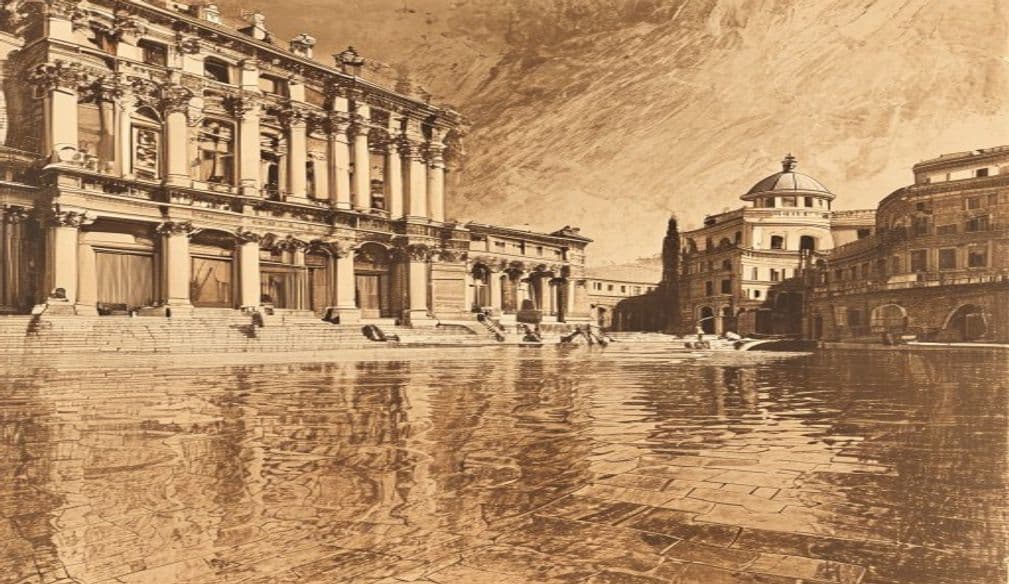
The origin of the name
The name Trevi almost certainly derives from the Latin trivium: the intersection of three roads. The area was already known in Roman times as a road junction, where three streets converged in the area corresponding to today's fountain piazza.
Rione Trevi is Rione III of Rome under the current administrative subdivision. Its historical boundaries vary, but it essentially comprises the area between the Quirinal to the east, the Pantheon to the west and Via Nazionale to the north.
Antiquity: the aqueduct and Agrippa's district
The neighbourhood's history is inseparable from the Aqua Virgo, the aqueduct built by Marcus Agrippa in 19 BC to supply his public baths on the Campus Martius. Twenty-one kilometres long, it was the most elegant of Roman aqueducts: it ran entirely underground, preserving the quality of the spring water.
The aqueduct passed directly beneath what would become the Rione Trevi, supplying the hydraulic network of the lower city. It remained in operation without interruption — except for brief medieval stoppages — and is still today the only functioning original Roman aqueduct, supplying the Trevi Fountain and other central fountains.
The Middle Ages: decline and survival
Like much of Rome, the Rione Trevi suffered a drastic population decline after the fall of the Western Roman Empire (476 AD) and the subsequent barbarian invasions. The aqueduct was sabotaged during the Gothic siege of the sixth century and remained partially inactive for centuries.
The medieval neighbourhood clustered around churches and repurposed Roman structures. Santi Apostoli (in the eastern zone) is one of the rione's oldest medieval churches. The Quirinal area was mainly occupied by gardens and vineyards until the Renaissance.
The Renaissance: rediscovery and reconstruction
The neighbourhood's great revival came in the 15th and 16th centuries, as the Roman papacy returned to stability after the Avignon schism. Pope Nicholas V (1447–1455) had the Aqua Virgo restored and commissioned a modest first fountain from architect Leon Battista Alberti in 1453, at the point where the aqueduct surfaced.
This fountain was the direct predecessor of the current Trevi Fountain: it marked the terminus of the aqueduct and was where Romans collected drinking water.
Over subsequent decades the neighbourhood densified: noble palazzi, workshops, parish churches. Piazza Barberini (then under a different name) was already a commercial hub.
The seventeenth century: the Barberini and Bernini
The seventeenth century belongs to the Barberini family. Pope Urban VIII (Maffeo Barberini, pope 1623–1644) transformed the rione into one of the most representative areas of Roman Baroque architecture.
The Barberini built Palazzo Barberini (today the Galleria Nazionale d'Arte Antica), one of the largest Baroque palazzi in Rome, designed by Carlo Maderno and completed by Bernini and Borromini. The Barberini bee emblem appears throughout the neighbourhood.
It was Urban VIII who commissioned from Bernini the Fontana del Tritone (1642–1643) and the Fontana delle Api (1644) in Piazza Barberini, which became the drawing room of the new aristocratic district.
The Trevi Fountain: the definitive project
The neighbourhood's most celebrated transformation came in the eighteenth century, when Pope Clement XII (Lorenzo Corsini) launched a competition in 1730 for the construction of a new monumental fountain at the terminus of the Aqua Virgo.
The winning design was by Nicola Salvi (1697–1751), chosen in 1732. Construction took almost thirty years: Salvi died in 1751 without seeing the fountain completed, and the project was finished by Giuseppe Pannini. The fountain was inaugurated on 22 May 1762 by Pope Clement XIII.
The Trevi Fountain is not merely a fountain: it is an entire façade integrating Palazzo Poli as a theatrical backdrop. It measures 49.15 metres wide and 26.3 metres tall, completely dominating the small surrounding piazza.
The eighteenth century: the Quirinal and Papal Rome
The Palazzo del Quirinale, construction of which began in 1573 under Gregory XIII, became during the eighteenth century the popes' summer residence, preferred to the Vatican for the more salubrious air of the hill. The rione took on a dual character: residential and artisanal in the lower sections, aristocratic and pontifical on the upper heights.
The churches of Sant'Andrea al Quirinale (Bernini, 1658–1670) and San Carlo alle Quattro Fontane (Borromini, 1634–1641) — at the border with Rione Castro Pretorio — attest to the density of Baroque architecture in the neighbourhood.
The nineteenth and twentieth centuries: the modern neighbourhood
With the end of the Papal States in 1870 and Rome becoming the capital of the new Kingdom of Italy, the Quirinal became the Savoy royal family's residence (and from 1946 the President of the Republic's official home). The neighbourhood retained its bourgeois and residential character.
Via Nazionale was opened in 1876 as a modern commercial artery. Via Veneto — today within the rione's perimeter — became in the 1950s and 60s the heart of Roman dolce vita: cafés, hotels, paparazzi and Hollywood actors.
The rione today
The Rione Trevi preserves a remarkable urban stratification: medieval streets, Renaissance and Baroque palazzi, ancient churches, eighteenth-century piazzas and the Trevi Fountain as the dominant element. Tourism concentrates around the fountain, but a few steps in any direction lead into a neighbourhood still inhabited, with bakeries, local markets, pharmacies and daily life.
Visit the Rione Trevi with a private driver
The neighbourhood is in a ZTL zone.
Visit the Rione Trevi with a private driver: discover Rome's historic quarter with direct, comfortable arrival. Service from €49. → Book your driver at myromedriver.com
Frequently asked questions
Why is the neighbourhood called Rione Trevi? The name probably derives from the Latin trivium (three roads), indicating an ancient road junction in the area of today's fountain piazza.
When was the Trevi Fountain built? The project was started in 1732 (Nicola Salvi) and the fountain was inaugurated in 1762 (Pope Clement XIII).
What was there before the Trevi Fountain? A more modest fountain, commissioned by Nicholas V and designed by Leon Battista Alberti in 1453, marking the terminus of the Aqua Virgo aqueduct.